
“The child who concentrates is immensely happy.” — Maria Montessori
You see happiness bloom when a child focuses deeply on a task. Research on flow by Mihaly Csikszentmihalyi shows that children feel joy and satisfaction when they become absorbed in meaningful activities. Studies on social and emotional learning programs reveal that strong concentration skills help children build confidence, improve relationships, and reduce anxiety. When you nurture focus, you support both emotional growth and lifelong happiness.
Key Takeaways
Encourage children to engage in activities that interest them. This leads to deeper focus and greater happiness.
Create a structured and nurturing environment. A quiet space and consistent routines help children concentrate better.
Introduce mindfulness practices. Simple breathing exercises and meditation improve focus and emotional regulation.
Celebrate achievements, both big and small. Acknowledging progress motivates children to stay engaged and strive for new challenges.
Support emotional intelligence. Helping children manage their emotions fosters better relationships and enhances their ability to concentrate.
The child who concentrates and happiness
Concentration and emotional well-being
You notice that the child who concentrates often shows a calm and joyful presence. Maria Montessori believed that deep focus brings happiness to children. She observed,
“The child who concentrates is immensely happy.” — Maria Montessori
When you give children the chance to focus, you help them build important skills for emotional well-being. Dr. Truglio, a child development expert, explains,
…we’ve learned through the research that it is those executive function skills, the ability to pay attention, the ability to focus your attention, but also be able to shift your attention and have flexible thinking, the ability to control your emotions that might be interfering with your ability to pay attention.
The child who concentrates learns to manage feelings and stay engaged, even when tasks become challenging. This ability supports a sense of inner peace and reduces stress. Montessori noticed that children often choose meaningful work over simple toys. They find happiness in activities that require effort and attention.
Montessori observed that children preferred engaging with educational materials over toys, indicating that meaningful work contributes to their happiness.
Younger children (ages 3-12) find more happiness from material goods than from experiences.
As children age, their happiness derived from experiences increases, eventually surpassing that from goods.
This shift in happiness is mediated by cognitive developmental factors such as memory and theory of mind.
You can see that as children grow, their happiness comes more from experiences that require focus and less from material things. The child who concentrates gains emotional strength and a deeper sense of satisfaction from these experiences.
Intrinsic motivation and joy
The child who concentrates often feels joy that comes from within. This joy is called intrinsic motivation. When children focus on a task because they enjoy it, they become more interested and confident. Research shows that children who have choices and can engage in games or activities that interest them learn better and feel happier.
Findings | Description |
|---|---|
Increased Interest | Children were more engaged when the learning activity was presented as a game. |
Enhanced Learning | Children learned more effectively when they had choices in the game. |
Higher Perceived Ability | Intrinsically motivated children showed greater confidence and sought more challenging tasks. |
You help the child who concentrates by offering activities that match their interests and abilities. When children feel in control of their learning, they take pride in their work and seek out new challenges. This process leads to a lasting sense of joy and accomplishment. The child who concentrates does not just complete tasks—they discover the happiness that comes from doing something meaningful.
Expert insights on concentration
Montessori’s approach
Maria Montessori believed that concentration is the foundation for all learning and happiness in children. She explained that you must work with the nature of the young child, not against it. Montessori said,
“To develop one’s ability to concentrate was essential to all else and, therefore, she began her work with this end in mind. Unless we work with the nature of the young child, we would be trying to attract a fleeting attention with our teaching efforts; instead, her approach was to ‘awaken’ the attention in the child by presenting a material that meets his developmental needs and encourages spontaneous repetition as the child tries to figure it out.”
You can see this in the Montessori classroom. The environment encourages long, uninterrupted work periods. A trained teacher observes your interests and connects you to materials that match your needs. Children work alongside peers who also focus, creating a respectful and calm atmosphere.
The Montessori environment encourages long, uninterrupted work periods of up to three hours.
Teachers connect you to materials by observing your interests.
You learn in a community where everyone values concentration.
Montessori emphasized that attention is not just an idea. You must develop it by working with materials that attract your interest. Research shows that Montessori students have stronger executive function and report more positive school experiences than students in traditional classrooms.
Evidence Type | Findings |
|---|---|
Executive Function | Montessori students demonstrated stronger executive function. |
School Experience | Montessori students reported a more positive school experience overall. |
Former Montessori students also score higher in psychological well-being, engagement, social trust, and self-confidence. The child who concentrates in this environment grows emotionally and socially.
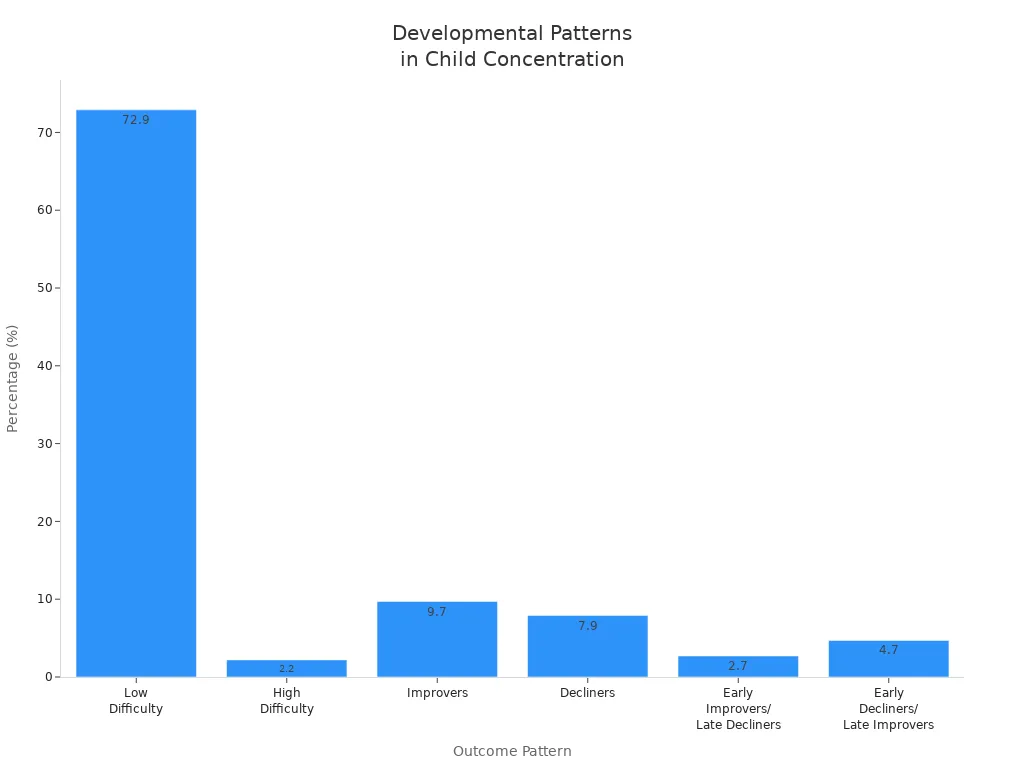
Targeted support in preschool settings can help many children improve their concentration skills, though some may still face challenges over time.
Csikszentmihalyi’s flow theory
Psychologist Mihaly Csikszentmihalyi introduced the idea of “flow.” You enter a flow state when you become so absorbed in an activity that you lose track of time and feel at peace. This state brings deep satisfaction and happiness.
Key Components of Flow in Early Childhood Education | Practical Applications for Educators |
|---|---|
Child-led learning: Autonomy in activity choice | Create enabling environments with open-ended materials |
Play-based learning: Incorporates flow elements | Support child-initiated activities for increased flow |
Developmentally appropriate practice: Optimal challenges | Scaffold learning to maintain challenge levels |
Holistic development: Cognitive, social-emotional, and physical growth | Provide clear goals and feedback in play contexts |
Foster social flow experiences in group activities | |
Integrate mindfulness practices to enhance concentration skills |
You can help children experience flow by giving them choices, offering open-ended materials, and supporting their interests. When you do this, children feel more engaged and happy. The child who concentrates often enters a flow state during creative activities, which helps them build an inner sense of satisfaction and joy.
Real-life focus in children

Art and creativity
You see children enter a state of deep focus when they create art. Drawing, painting, or building with clay requires attention to detail and patience. These activities help you develop critical thinking and communication skills. When you work on an art project, you use memory and focus, which can improve your ability to remember information and do better in school. The process of solving problems in art, such as choosing colors or fixing mistakes, helps you build resilience and a growth mindset. This growth leads to greater happiness and satisfaction.
Engaging in creative arts enhances cognitive skills like critical thinking and communication.
Art activities require memory and focus, improving academic performance.
Problem-solving in art fosters resilience and a growth mindset, which supports happiness.
Play and problem-solving
Play gives you a chance to practice focus in a fun way. When you solve puzzles or build with blocks, you use your mind to find solutions. Free play encourages you to take initiative and become more independent. You also develop social, emotional, language, and literacy skills through play. Children who explore objects and try new things often become better problem-solvers. This kind of play strengthens your ability to concentrate and stay engaged.
Activity | Benefit |
|---|---|
Solving puzzles | Builds problem-solving skills and persistence. |
Completing obstacle courses | Combines physical and mental effort, teaching perseverance. |
Free play | Encourages independence and supports social and emotional growth. |
Exploring objects | Fosters focus and engagement, leading to better problem-solving skills. |
Learning in the classroom
You can improve your concentration and happiness through classroom routines. Teachers often include breaks to help you refresh your mind. A quiet area for naps benefits younger children, while free time lets you unwind and recharge. Nutritious snacks keep your energy up, making it easier to focus. Dr. Montessori reminds us, “The child who concentrates is immensely happy.” When you have meaningful work and a supportive environment, you find it easier to focus and feel satisfied with your learning.
Activity Type | Description |
|---|---|
Breaks | Short breaks help you regain focus and stay alert. |
Quiet Area | A calm space for rest supports younger children’s concentration. |
Free Time | Unstructured time allows you to relax and reset. |
Nutritious Snacks | Healthy snacks maintain your energy for better focus. |
Observable effects of focus
Pride and accomplishment
You notice a sense of pride when you concentrate and complete a task. Focus helps you see progress and reach goals. You feel satisfaction when you finish a puzzle, solve a math problem, or create a piece of art. This feeling of accomplishment encourages you to try new challenges. You learn that effort leads to results. When you share your achievements with others, you build positive relationships. You also inspire your peers to work hard and stay focused.
“Success is the result of preparation, hard work, and learning from failure.” — Colin Powell
You develop a growth mindset by celebrating small wins. Each time you focus and succeed, you believe more in your abilities. This belief helps you set higher goals and stay motivated.
Calm and balance
You experience calm and balance when you pay attention to the present moment. Mindfulness practices teach you to notice your thoughts and feelings without judgment. You learn to breathe deeply and relax your body. These skills help you manage stress and stay peaceful during challenges.
Mindfulness encourages you to develop self-regulatory skills.
Mindfulness practices improve executive functions, which help you control emotions.
School-based mindfulness programs teach coping skills for stress and anxiety.
Meditation and physical activity enhance sustained attention, leading to greater calmness.
Mindfulness training has consistent positive effects on selective attention.
You find that focusing on one activity at a time makes you feel less overwhelmed. You handle difficult situations with more patience. You build a sense of balance that supports your emotional health.
Confidence and self-esteem
You gain confidence when you concentrate and see your progress. Focus helps you master new skills and understand complex ideas. You trust yourself to solve problems and make decisions. Each success boosts your self-esteem. You feel proud of your abilities and want to keep learning.
You also become more independent. You rely less on others for help. You believe in your strengths and know you can overcome obstacles. This confidence helps you face new experiences with courage and curiosity. You grow into a resilient and happy person.
Nurturing concentration daily
Supportive environments
You help children focus when you create a structured and nurturing space. A quiet study area with comfortable seating and good lighting makes it easier to pay attention. Organized routines and visual cues reduce distractions and help children feel secure. You can set up a clutter-free classroom or home space and use sensory modifications, such as soft music or calming colors, to support attention growth. When you tailor activities to a child’s interests, you promote sustained focus and skill development. Consistent routines also lower uncertainty, allowing children to concentrate better.
Set up a quiet study space free from distractions.
Establish a consistent routine for learning and play.
Use visual cues and sensory modifications to support attention.
Organize activities based on your child’s interests.
Provide comfortable seating and adequate lighting.
Mindful activities
You boost concentration and happiness by introducing mindful activities. Mindfulness and meditation teach children to notice their thoughts and feelings. These practices improve self-regulation, reduce anxiety, and help children respond calmly to challenges. You can use simple breathing exercises, short meditation sessions, or guided imagery. Mindfulness rewires the brain, leading to greater personal effectiveness and kindness. Children who practice mindfulness show improved focus, better grades, and increased compassion.
Practice mindfulness and meditation regularly.
Use breathing exercises to calm the mind.
Try guided imagery or short meditation sessions.
Encourage reflection on thoughts and feelings.
Promote regular exercise, sleep, and a nutritious diet.
Celebrating focus
You reinforce concentration by celebrating focused engagement. Acknowledge achievements, both big and small, to motivate children. Personalize celebrations to match your child’s preferences and let them help plan the event. Create family traditions that honor milestones, such as finishing a book or solving a puzzle. You can organize playdates or group activities to practice social skills. Recognize moments of sharing and cooperation to encourage repetition. The child who concentrates thrives when you celebrate their effort and progress.
Acknowledge achievements and milestones.
Personalize celebrations for your child.
Involve your child in planning celebrations.
Establish family traditions for recognizing success.
Celebrate small wins to foster ongoing motivation.
Lasting impact of the child who concentrates
Expert quotes
“The child who concentrates is immensely happy.” — Maria Montessori
“Happiness is not something that happens. It is not the result of good fortune or random chance. It is not something that money can buy or power command. It does not depend on outside events, but, rather, on how we interpret them.” — Mihaly Csikszentmihalyi
You see that experts agree. Concentration shapes happiness in childhood and beyond. Montessori believed that deep focus builds joy and emotional strength. Csikszentmihalyi explained that happiness grows from meaningful experiences, not from outside rewards. You help children find fulfillment when you encourage focus and engagement.
Takeaways for adults
You can support children’s happiness and future well-being by nurturing concentration every day. Research shows that children who engage in meaningful activities often reach a state of flow. This state links directly to happiness and satisfaction. You guide children to reflect on their strengths and preferences. Daily reflection helps them understand what makes them feel fulfilled.
Encourage children to choose activities that interest them. Meaningful engagement leads to flow and happiness.
Guide children in daily reflection. Help them notice their strengths and preferences.
Support emotional regulation. Children who manage their emotions focus better and build stronger friendships.
Prioritize well-being. Happy children often grow into adults who enjoy work and social connections.
Foster emotional intelligence. Strong relationships and self-awareness contribute to lifelong psychological health.
You see the lasting impact when you nurture concentration. Children develop skills that help them succeed in school, work, and relationships. You build a foundation for happiness that lasts into adulthood. Every moment of focus you support today shapes a brighter future.
You see that concentration unlocks happiness for children. Montessori and flow research show that focused attention leads to joy, calm, and emotional strength.
“A child who has become master of his acts through long and repeated exercises…is a child filled with health and joy and remarkable for his calmness and discipline.”
To nurture lasting well-being, you can:
Reduce screen time and encourage outdoor play.
Create structured routines and calming zones.
Support open communication and affection at home.
You help children thrive when you guide them to focus and grow.
FAQ
How can you tell if your child is concentrating?
You notice your child focusing on one task for a long time. They may ignore distractions and show deep interest. Their body language looks calm and engaged. You see fewer signs of restlessness or boredom.
What activities best support concentration in children?
You can encourage activities like puzzles, drawing, reading, or building with blocks. Outdoor play and hands-on science experiments also help. Choose tasks that match your child’s interests and skill level.
Does screen time affect your child’s ability to concentrate?
Yes, too much screen time can make it harder for your child to focus. You help by setting limits and encouraging breaks. Try to balance screen use with active, creative, or social activities.
How do you help your child build concentration at home?
Tip: Create a quiet, organized space for homework or play.
You can set routines, use visual reminders, and praise focused effort. Offer choices and let your child take breaks when needed.

No responses yet